A parent in Kitchener sat across from me on a recent intake call, laptop propped open, her four-year-old narrating a dinosaur battle somewhere off-camera. She’d been offered two paths for her son’s autism therapy: an in-home program with a therapist arriving twice a week, or a virtual program built around video sessions and parent coaching. “Which one actually works?” she asked.
It’s one of the most common questions Ontario families ask before starting therapy, and it deserves a straight answer rather than a sales pitch. The short version: online autism treatment can be genuinely effective, but “as effective as in-person” isn’t a simple yes or no. It depends on the child, the goal, and how the program is run. Here’s what the research and years of clinical practice actually show.
What the Research Actually Says
Applied Behavior Analysis (ABA) delivered through telehealth has been studied fairly closely since it became widespread during the pandemic, and the findings are more encouraging than most parents expect. A large 2025 evidence review compiled for a state Medicaid program, drawing on dozens of peer-reviewed studies, found that parent-mediated ABA delivered by telehealth was linked to meaningful reductions in challenging behavior across several trials. Peer-reviewed research published in journals like Behavior Analysis in Practice and the Journal of Developmental and Physical Disabilities has documented comparable gains in language, social communication, and adaptive skills through both direct telehealth therapy and telehealth-based parent training.
That same evidence review also flagged real, practical barriers worth naming honestly: unreliable internet connections, distractions in the home during sessions, and the simple difficulty of a therapist demonstrating a hands-on technique — or catching a subtle behavioral cue — through a camera with a limited field of view. None of that rules out telehealth. It just means a good provider builds a plan around those limits instead of pretending they don’t exist.
Not every study points the same direction, either. One study tracking caregiver satisfaction during the pandemic found that parents rated telehealth-delivered ABA, speech, and occupational therapy somewhat lower than in-person care — particularly when their child had more difficulty with emotional regulation. That’s a useful reminder that “effective” and “preferred” aren’t always the same thing, and both matter when you’re choosing a program for your own child.
What a Virtual ABA Session Actually Looks Like
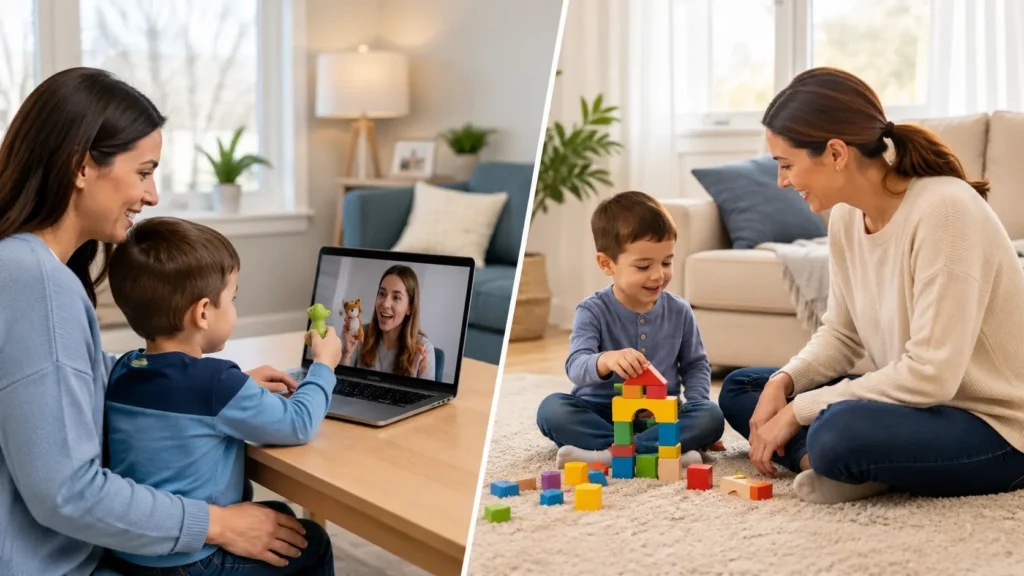
A typical virtual session runs much like an in-person one, just delivered through a secure video platform instead of a living-room visit. A therapist or BCBA guides the child directly, or coaches the parent through structured teaching opportunities — naturalistic, play-based teaching, more structured trials, or a mix of both — while collecting the same kind of data used in in-person sessions to track progress toward specific goals. Sessions are often shorter and more frequent than a single long in-home visit, which some children tolerate better than one longer block of time.
For parent-coaching models specifically, the therapist typically watches the parent interact with the child in real time and gives live feedback, then reviews the session data afterward to adjust the plan for next time. The technology requirements are modest: a stable internet connection, a device with a working camera, and a reasonably quiet space — not a dedicated therapy room or special equipment.
Where Online Autism Treatment Works Best
In practice, virtual therapy tends to shine in a few specific situations:
- Parent-mediated learning. Because a coach can watch and guide a caregiver in real time, virtual sessions are especially strong for teaching parents to run interventions themselves — which is also the entire premise behind parent coaching in Ontario programs. Skills taught this way tend to generalize well, simply because they’re practiced in the same environment the child lives in every day.
- Reduced novelty stress. Some children learn better at their own kitchen table than in an unfamiliar clinic, because there’s one less transition to manage before therapy even starts.
- Access. Families outside major hubs — including many communities served through ABA therapy in London and the surrounding region — often face longer waitlists or fewer in-person provider options. Virtual therapy can close that gap without a family having to travel further or wait longer than necessary.
- Consistency. Illness, weather, or scheduling conflicts are far less likely to cancel a session entirely when therapy doesn’t depend on someone driving to your door.
Where In-Person Therapy Still Has an Edge
Online therapy isn’t the right fit for every goal, and a good provider will tell you that plainly.
- Very young children or early learners. Toddlers who are just beginning to build joint attention, imitation, or basic communication often need hands-on physical prompting that’s genuinely difficult to deliver through a screen.
- Significant behavioral concerns. When a program involves managing safety-related behaviors like elopement or aggression, having a therapist physically present matters.
- Limited screen tolerance. Some children don’t yet attend well to a video format, no matter how engaging the therapist is.
For families weighing this trade-off, ABA therapy at home in Ontario often becomes the middle ground: a therapist working directly with your child in a familiar setting, without the commute or waitlist pressure of a clinic visit.
The Hybrid Approach: Why Many Ontario Families Do Both
In our experience, the families who see the strongest outcomes rarely pick one format exclusively. A common and effective structure pairs direct, hands-on sessions for goals that need physical proximity with virtual sessions for parent coaching, data review, and consultation. This hybrid model tends to combine the strengths of both: steady, hands-on skill-building in person, plus the flexibility and caregiver involvement that virtual sessions do especially well.
How to Decide What’s Right for Your Child
Before committing to a format, it’s worth asking a provider a few direct questions:
- Who is supervising the program — is a Board Certified Behaviour Analyst (BCBA) overseeing both in-person and virtual sessions equally?
- How is progress measured and reported specifically for virtual sessions?
- If a goal isn’t progressing online, is there a clear plan to shift it to in-person support?
- Does your funding, including OAP, apply the same way to virtual sessions as it does to in-person ones? In most cases it does, but it’s worth confirming with your service coordinator.
Frequently Asked Questions
Is online autism treatment as effective as in-person ABA therapy?
For many goals — especially language, social skills, and parent-implemented strategies — research shows outcomes comparable to in-person therapy. For very young children or safety-sensitive behaviors, in-person support is usually still the better starting point.
Does OAP funding cover virtual ABA therapy in Ontario?
In most cases, yes — OAP funding can generally be used for virtual ABA sessions the same way it’s used for in-person therapy, though it’s worth confirming the specifics with your service coordinator.
Is online ABA therapy appropriate for toddlers?
It can be, particularly for parent-coaching models where a therapist guides a caregiver in real time during play. For toddlers who need hands-on physical prompting, in-person or hybrid support is usually recommended instead.
Can we switch between online and in-person therapy as our child grows?
Yes. Most Ontario providers regularly adjust the format as a child’s needs change — starting in person and shifting toward more virtual support, or the reverse, is common and expected.
Is online autism treatment covered by private insurance in Ontario?
Coverage varies by provider and plan. Many extended health plans that cover ABA therapy also cover virtual sessions, but it’s worth checking your specific policy before starting.