
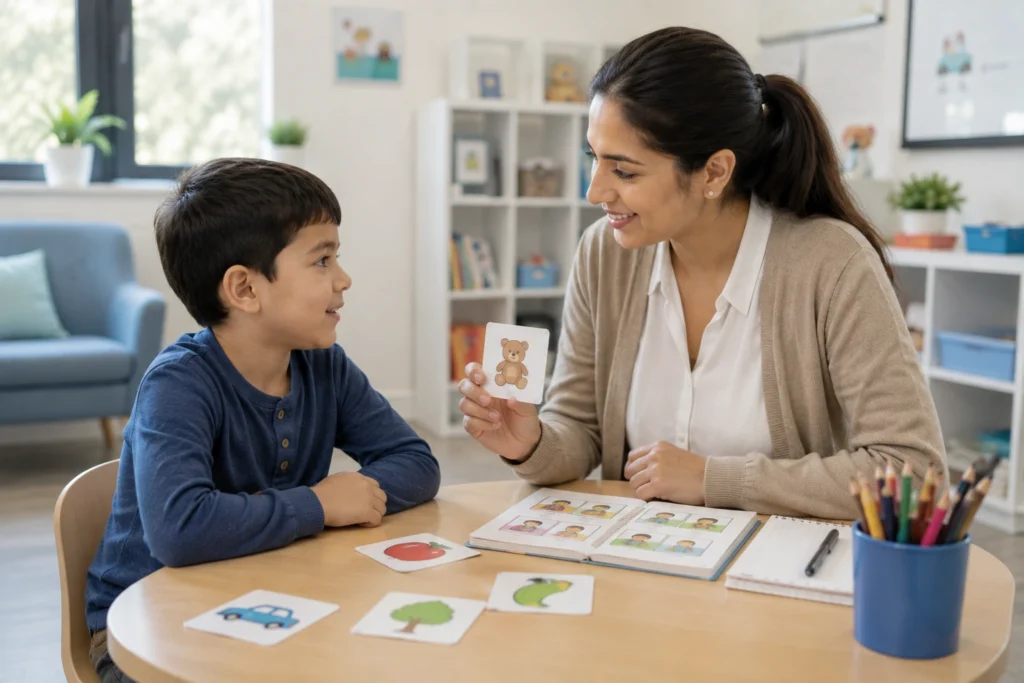
A mom in Mississauga once told me she spent an entire year telling herself her son was “just quiet.” He pointed at what he wanted instead of asking. He understood everything she said but rarely said much back. Family members kept saying boys talk later, that he’d catch up on his own time. By the time they sat across from me for an assessment, he was three and a half, and she was carrying a quiet kind of guilt for not trusting her gut sooner.
I hear some version of that story every few weeks. Parents aren’t wrong to wonder whether a quiet toddler is simply cautious, or a late talker who’ll bloom in their own time. Some are. But there’s a real difference between a child who’s a little behind and one who’s showing a pattern of true delay, and knowing that difference early changes what happens next. Here’s what actually separates the two, based on developmental research and years of sitting across from families asking the same question.
Why Catching This Early Actually Matters
Speech and language problems are far more common than most parents expect. Roughly one in ten preschoolers needs some kind of extra support with communication. The brain is also doing its fastest work on language in the first few years of life, which is exactly why speech-language pathologists talk so much about early intervention rather than a “wait and see” approach. A child who gets support at two has more runway to catch up before school starts than a child who gets the same support at five.
That doesn’t mean every quiet toddler needs therapy. It means the signs below are worth paying attention to, not brushing off.
Age-by-Age Signs Worth Watching
By 12–15 months: No babbling with a mix of consonant and vowel sounds, no attempt to imitate sounds or gestures, and no response to their own name.
By 18 months: Fewer than roughly 10–20 words, no pointing to show or request things, and little interest in pointing out objects to share attention with a caregiver.
By 2 years: A vocabulary under about 50 words, no two-word combinations (“more juice,” “go car”), and difficulty following simple one-step directions without gestures.
By 3 years: Speech that’s still largely unintelligible to unfamiliar listeners, no short sentences, and trouble answering simple questions like “what’s your name.”
By 4 years and up: Noticeable grammar errors that persist, difficulty telling a simple story in order, or trouble being understood by people outside the immediate family.
At any age, regardless of age-based milestones: A sudden loss of words or skills the child previously had. Regression is one of the clearest red flags in child development and always warrants prompt follow-up, not a wait-and-see approach.
Risk Factors That Raise the Odds
A few background factors don’t cause a delay on their own, but they do mean it’s worth watching more closely: a family history of speech, language, or learning differences; frequent ear infections or fluid in the ears, which can affect how clearly a child hears sounds during key learning months; premature birth; and bilingual or multilingual homes, which can shift the timeline slightly but shouldn’t be assumed to explain away a genuine delay. If any of these apply to your child alongside the signs above, that’s more reason to get an assessment sooner rather than later, not less.
When It Might Be More Than “Just” Speech
Language delay on its own is common and often resolves with straightforward speech therapy. But sometimes it shows up alongside other differences — limited eye contact, not responding consistently to their name, narrow or repetitive play interests, or difficulty with back-and-forth interaction. When language delay travels with those other signs, it’s one of the most common reasons families end up pursuing a broader developmental assessment rather than a speech-only one.
This is also where timing matters most. The children who make the fastest, most durable progress are usually the ones whose families pursued early intervention as soon as a pattern became clear, rather than waiting for a formal diagnosis to “confirm” what they were already noticing.
What To Do If You’re Seeing These Signs
Start by writing down specifics: how many words your child uses, whether they combine words, how they respond when you call their name from across the room. Specifics help a professional far more than “he’s just behind.”
In Ontario, every region has a free Preschool Speech and Language Program funded by the Ministry of Children, Community and Social Services, and most allow parents to self-refer online without a doctor’s note or OHIP card. It’s often the fastest first step, and it costs nothing to get on a waitlist while you sort out whether more comprehensive support is needed.
If your child’s daycare educator has mentioned similar concerns, take that seriously — educators see dozens of children at the same age and often notice patterns before parents do, simply because they have more comparison points. Some programs, including ABA therapy at daycare in Ontario, work directly with your child’s existing daycare setting so support happens where your child already spends their day, rather than adding another appointment to your week.
How ABA and Language Therapy Work Together
Speech-language pathologists and behavior therapists often work from different training but toward the same goal: functional communication your child can use in real life. In practice, that frequently means language goals — requesting, labelling, answering questions, having a back-and-forth exchange — get built into an ABA program alongside a speech therapist’s direct work. Families in the GTA who pursue ABA therapy in Mississauga often coordinate both services at once so progress in one setting reinforces the other, instead of the two teams working in isolation.
For younger children especially, a lot of that carryover happens at home. ABA therapy at home in Ontario lets a therapist work on communication goals in the exact environment where your child needs to use those skills — asking for a snack, protesting appropriately, joining a sibling’s game — which tends to generalize faster than skills practiced only in a clinic.
Frequently Asked Questions
What’s the difference between a speech delay and a language delay?
A speech delay affects how clearly a child pronounces sounds. A language delay affects understanding or using words and sentences to communicate meaning. Some children have one, some have both, and a speech-language pathologist can tell you which you’re dealing with.
Is it true that boys just talk later than girls?
There’s a small average difference, but it’s not large enough to explain a true delay. If your child is missing several milestones for their age, “he’s a boy” isn’t a reason to wait rather than get an assessment.
Do I need a doctor’s referral to access speech therapy in Ontario?
No. Ontario’s Preschool Speech and Language Program accepts self-referrals directly from parents, and services are free for children from birth until they’re eligible to start school.
Could a language delay be an early sign of autism?
It can be, especially when paired with other differences like limited eye contact or reduced response to their name — but a language delay alone doesn’t mean autism. A broader developmental assessment is the only way to know for sure.
My child is only 18 months old — isn’t it too early to worry?
It’s never too early to get information. Early screening doesn’t commit you to anything; it either reassures you or gets your child connected to support while their brain is doing its fastest developmental work.