
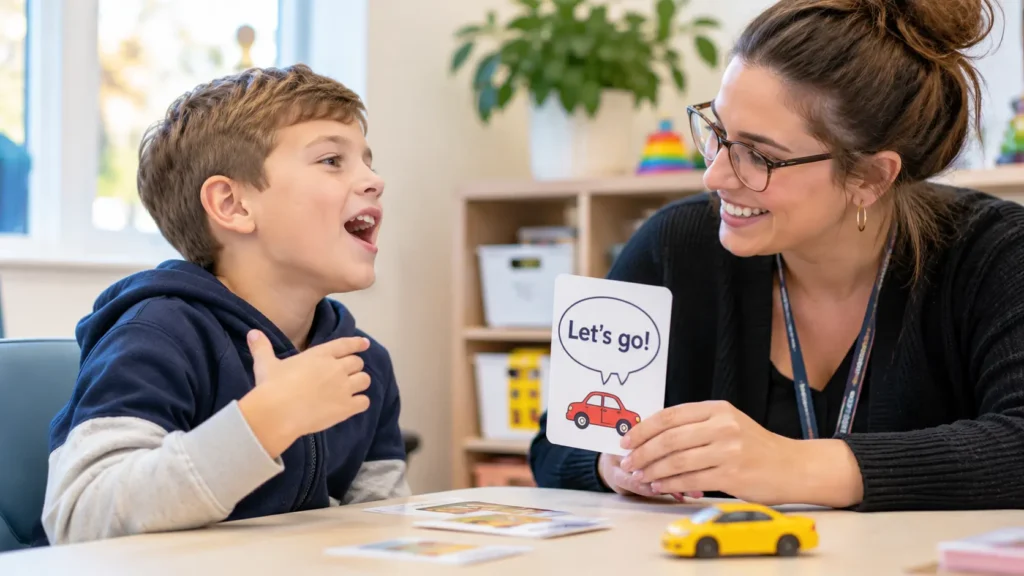
Imagine asking your child, “Do you want some water?” Instead of answering, they repeat your question word for word. Later, you hear them repeating a favourite cartoon phrase while playing.
You may wonder why this happens and whether your child understands what they are hearing.
This behaviour is called echolalia in autism, and it can be an important part of how autistic children process language and communicate.
Although repeated speech might seem confusing, it can express needs, emotions, or interests. Understanding its purpose helps parents respond positively and encourage meaningful communication.
What Is Echolalia in Autism?
Echolalia is the repetition of words, phrases, or sentences previously heard from another person, television programme, or other source.
Echolalia in autism is not always meaningless repetition. Children may use familiar phrases to request something, express excitement, process information, or regulate emotions.
Echolalia can also appear during typical early language development. However, persistent repetition alongside other communication differences may indicate a need for developmental assessment.
Immediate Echolalia
Immediate echolalia occurs when a child repeats words shortly after hearing them.
Example:
Parent: “Are you ready to play?”
Child: “Ready to play?”
The child may be processing the question, showing interest, or participating in the interaction.
Delayed Echolalia
Delayed echolalia happens when a child repeats phrases heard hours, days, or weeks earlier.
For example, a child might say, “Let’s go on an adventure!” when they want to visit the playground because they remember hearing it in a cartoon.
These familiar expressions may have meaningful communication purposes.
Why Does Echolalia Happen in Autistic Children?
There is no single cause of echolalia in autism. Its purpose varies depending on the child, environment, and situation.
1. Processing Spoken Language
Some autistic children need additional time to understand spoken information.
Repeating a question may accompany language processing, although repetition does not necessarily indicate understanding.
2. Expressing Needs and Feelings
Children sometimes use memorized phrases when creating new sentences is challenging.
For example, saying “Let’s have lunch!” may communicate hunger.
Recognizing these expressions helps parents understand possible communication attempts.
3. Finding Comfort Through Repetition
Familiar phrases may provide reassurance during stressful or unfamiliar situations.
A child might repeat a favourite television line while waiting for an appointment or adjusting to a new environment.
4. Developing Language Skills
Some children gradually adapt repeated phrases into more flexible communication.
Others continue using familiar expressions as meaningful parts of their language.
Individualized early intervention ABA therapy may help children build communication and daily living skills while respecting their individual needs.
Common Echolalia Examples in Everyday Life
Echolalia can occur during meals, playtime, daily routines, and conversations.
| Situation | Repeated phrase | Possible meaning |
| Offered juice | “Want some juice?” | Requesting juice |
| Preparing for bed | “Sleepy time!” | Recognizing bedtime |
| Feeling overwhelmed | Favourite cartoon phrase | Seeking comfort |
| Visiting a playground | “Let’s go outside!” | Expressing excitement |
| Asked a question | Repeats the question | Processing or responding |
These examples represent possible meanings rather than definite interpretations.
Context is essential when understanding echolalia.
Pay attention to your child’s gestures, facial expressions, surroundings, and actions.
For example, if your child repeats “All done!” while pushing away their dinner plate, they may be communicating that they have finished eating.
Observing these patterns can help parents understand their child’s individual communication style.
How to Support Communication in Children With Echolalia
Supporting echolalia does not mean eliminating repeated speech. Instead, focus on helping children communicate effectively and comfortably.
1. Respond to Communication Attempts
When your child repeats a phrase, consider what they may be trying to express.
If they say, “Want a cookie?” while pointing toward the cupboard, respond naturally:
“You want a cookie!”
This acknowledges their message without criticizing their speech.
2. Model Simple, Meaningful Language
Use short phrases that match everyday situations.
Instead of repeatedly asking, “What would you like to drink?” model a useful expression such as “I want water.”
Avoid forcing your child to repeat sentences perfectly.
3. Introduce Visual Communication Supports
Pictures, gestures, communication boards, and augmentative and alternative communication (AAC) tools can support language development.
For example, offering pictures of milk and water allows children to communicate preferences without relying entirely on spoken words.
These approaches can reduce communication frustration.
4. Practise During Everyday Activities
Meals, dressing, and playtime provide natural opportunities to develop communication skills.
During in-home ABA therapy, communication activities can be incorporated into familiar routines and enjoyable interactions.
5. Allow Extra Response Time
Some children need additional time to process questions.
After speaking, pause and give your child an opportunity to respond.
Avoid repeating instructions too quickly or asking several questions simultaneously.
Parents can also explore ABA parent coaching to learn practical strategies for supporting communication at home.
When Should Parents Seek Professional Support?
Echolalia itself does not always require treatment. However, additional support may be helpful when communication difficulties affect daily activities or relationships.
Consider consulting a qualified speech-language pathologist if your child:
- Struggles to communicate basic needs.
- Experiences frequent communication frustration.
- Has difficulty understanding simple instructions.
- Shows limited development of functional communication.
- Loses previously acquired language or social skills.
A speech-language assessment can help identify communication strengths, challenges, and appropriate support.
Families may also consider online autism therapy in Ontario for individualized behavioural support and parent guidance.
Treatment decisions should reflect the child’s abilities, preferences, and developmental needs. When comparing ABA therapy in Canada, ask providers how they respect a child’s communication style and preferences.
Frequently Asked Questions
Is echolalia always a sign of autism?
No. Echolalia can occur during typical language development and with other communication conditions. Repeated speech alone cannot confirm an autism diagnosis.
Can children with echolalia develop conversational speech?
Yes. Some children develop more flexible conversational language over time. Progress varies, and gestures, AAC, and other communication methods remain valuable.
Should parents stop echolalia?
Generally, parents should not automatically discourage repeated speech. Echolalia may support communication or emotional regulation. Understanding its purpose is more useful than simply trying to eliminate it.
Conclusion
Echolalia in autism can be a meaningful way for children to communicate, learn language, and express emotions.
By recognizing repeated phrases, responding patiently, and using appropriate communication strategies, parents can support their child’s development.
Every child’s communication journey is different, and progress may involve spoken language, gestures, visual supports, or AAC.
If you have concerns about your child’s communication development, contact Ontario ABA Therapy to discuss individualized support options and consider consulting a registered speech-language pathologist.
Disclaimer: This article is for educational purposes and does not replace professional medical, developmental, or speech-language advice.